Intermediate/Advanced
Info:
Published 2023, 142 pages, 223 diagrams, softbound.
Price (excluding UK/EU/Europe):
$70.00
(price UK: £51.00, EU/Europe: €63.00, Denmark: kr 460.00)
About the book:
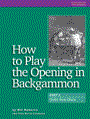
How to Play the Opening in Backgammon/Part 3 – Order from Chaos covers some key opening concepts that weren’t discussed in Books 1 and 2 and sheds some light on some situations that haven’t really been described in the literature at all.
The third chapter, for example, talks about the Outfield. When do you run to the outfield, and when don’t you? But even more important, what do you do when you run to the outfield and don’t get hit? Do you quickly run that blot to safety, or do you recognize that the blot is now as much an asset as a liability, and leave him where he is?
The last chapter discusses doubling in the very early part of the game, in positions which aren’t blitzes. Such doubles not only exist, but are much more common than you might think. The book lays out some examples and rules of thumb for identifying these doubles. And the chapter concludes with some advice for avoiding that most dreaded of opening traps – the horrific Blockhead
Blockchain!
Traditionally, advice about backgammon opening strategy has focused on which points
you're trying to make and why. "The 5-point is strong." "The ace-point is weak." "You
can't go wrong making the 20-point." And so on.
In this series, the focus instead is on treating an early position as more akin to a financial
problem, where assets and liabilities have to be carefully weighed against one another
to find the right play. It's based on the premise that when there isn't a clearly right move
(which is much of the time) it's likely that multiple features of the position -- some
obvious and some subtle -- will have an influence on the decision of which play to make.
This book concludes a three-book series on how to play in the opening. It continues
where Part 2 left off, explaining the intricacies of slotting and stacking, followed by
splitting and building. It then moves on to cover the whole topic of outfield play — when
you run to the outfield, when you don't, and how to handle outfield blots when they
arise. After that we look at situations where one side has escaped one or both back
checkers. Finally, the last chapter discusses positions where one side may or may not
have a double, despite a lack of inner board points.
By knowing what features of the position are likely to matter for a given set of choices,
How to Play the Opening in Backgammon: Order from Chaos will give you more of the tools to
let you quickly spot the best play at the board.
BACK |